The International Association
of Hyperpolyglots
HYPIA
Est. 2016
Interview with
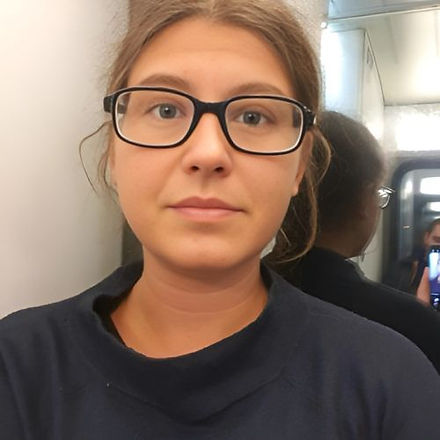
Felicitas Andermann
Name: Felicitas Andermann
Nationality or Ethnicity: German
Where do you live?: Leipzig, Germany
Languages: German (L1), English (C1), French (B2), Italian (B2), Catalan (B2), Czech (B1), Serbian (B1), Spanish (B1, never formally studied), Irish (A2), Russian (A2), Upper Sorbian (A1).
Member since:
5 de mayo de 2026
1. What’s your story? How did you get into all these languages?
It was my mother who taught me my first English phrases when I was five. They included this old-fashioned greeting pattern [see Example 1]:
(1) Greeting pattern
A: How do you do?
B: How do you do?
A: How are you?
B: I’m fine. How are you?
A: I’m fine, thank you.
From the age of 7, I learned both English and French at school (I went to a Waldorf school where children learn two foreign languages from the age of 7) but also at home, thanks to my mother who made me read English and French children's books and occasionally spoke English to me. Soon I realised that I could use the words I learned at home in class at school and vice versa, which was a deeply satisfying experience. Even outside of school or home, whenever I ran into a native English or French speaker, I would try my few words in English or French on them and was delighted to see their happy faces when they understood me. Moreover, I was top of the class in both English and French, and people told me I had a gift for languages.
Besides, I was fascinated by grammatical structures, especially verb tense forms. At the age of 14, I realised that the future tense endings in French are almost identical to the present tense forms of the verb avoir, 'to have'. At the age of 15, I found that the conditional forms of French verbs are made of the future tense stem and the imparfait tense endings. I also stumbled across two tense forms in the grammar section of my French dictionary that we had not learned – the passé simple and the subjonctif imparfait – and I taught them to myself. My new passion for the French language had another positive side effect: My classmates stopped bullying me, as they needed me to explain French grammar to them.
At the age of 16, I finally realised that languages are my thing and I want to do something with languages in my life. When my school required me to write a term paper on a topic of my choice, I wrote it on the grammar of Irish (my mother was obsessed with Ireland and took my father and me there every year in the winter holidays. One time my father bought a CD Irish course and gave it to me saying "Here, this is for you so you can learn Irish". Later I found out that he had meant it more as a joke…).
I also participated in the national German foreign language competition (Bundeswettbewerb Fremdsprachen) and was accepted to the final round but only won a 3rd prize. The next year, I was determined to win at least a 2nd prize, so I learned an additional language, Italian.
In fact, even though I started learning English very early, my very first foreign language input must have been in Italian. When I was four, my parents bought an old house in northern Tuscany where we’d spend every summer until 2018. I loved the house, the nature around it and the river nearby, but was scared of the people (the reason for that is another story) and disliked the language, because it had too many low and low-mid vowels, which I found ugly at that time. This, however, did not keep me from being utterly fascinated by the logic of the Italian imperative pattern [see Example 2] at the age of 10:
(1) Italian imperative rule
a. When the infinitive ends in -are, the informal imperative ends in -a and the formal imperative ends in -i
b. When the infinitive ends in -ere or -ire, the informal imperative ends in -i and the formal imperative ends in -a
In other words, the informal imperative forms end in a vowel that is closer to that in the infinitive, and the formal imperative forms end in a vowel that is further away from that in the infinitive. Just like using the informal form means being closer to the addressee and using the honorific implies distance.
At the national foreign language competition, one of the other finalists told me that one could study both translation and Irish language at Leipzig university, so I went to Leipzig and did my BA in Translation Studies with English and French and later also Catalan as working languages.
In Leipzig you can study Catalan from zero and become a translator for Catalan within three years. I met the Catalan lecturer at a minority language translation festival and suggested that I could talk to him in Italian and he could answer in Catalan, to which he replied in Italian, Devi imparare il catalano. So I spontaneously decided to attend his Catalan classes. With my knowledge of both French and Italian, I learned Catalan very quickly and received a B1 certificate from Institut Ramon Llull after eight months. When, soon afterwards, Institut Ramon Llull offered a Catalan-to-German literary translation class for 10 students from all over Germany, Austria and Switzerland, my Catalan lecturer not only encouraged me to apply, but also recommended me to the institute to make sure I got admitted.
Unlike Catalan, I have never learned Spanish formally but I can understand it. Whenever I meet Spanish speakers, I try to talk to them in Catalan and they reply in Spanish. This way I also picked up some Spanish expressions and if it is really necessary, I can also speak some "invented" Spanish by taking words from French, Italian and Catalan and applying the relevant phonological processes to them.
Towards the end of my BA, I decided that translating instruction manuals or contracts all day was not what I wanted to do in life. Since I still wanted to do something with languages and was fascinated by grammatical structures, I took a couple of classes in general linguistics, which I liked so much that I did my MA in general linguistics and joined a research project at the linguistics department at Leipzig university. There I met my best friend, who was learning Czech at that time and spontaneously joined her Czech class to prepare for Polyglot Gathering 2023 in Prague. Even though it was an A2 class and I had no previous knowledge of Czech (I had taken three semesters of Russian though), I caught up with the rest of the students pretty quickly, especially because my friend and I tried to talk to each other in Czech – or rather a Czech-German pidgin – as much as possible. One year later, we also took Serbian classes together and our Czech-German pidgin became a Czech-German-Serbian pidgin. One time in Serbian class, she had to fold (German falten) a piece of paper, and said Musím to faltovat, and I corrected her to Moram to faltovati.
In the meantime, I have been to Czech Republic a couple of times – now (from 9th February to 19th June 2026) I am even doing an internship in Plzeň – and to Zagreb once. In both Czech Republic and Croatia, I tried to speak the local language to people and was amazed at how they reacted – no matter how bad my Czech or Croatian was, most of them did not switch to English but just replied in Czech and Croatian, respectively.
I would not have been able to learn these languages if it were not for the people I met along the way who helped and are still helping me, and I am infinitely grateful to all of them – my mother, my friends, the teachers at school and lecturers at university, and the countless people I talked to on the street, in the supermarket, on the train…
2. Which language(s) do you wish you could spend more time practising?
All of them. Especially Russian and Irish, but also French. Since my student exchange semester in 2017, I haven’t spoken a word of French and, while I still understand everything, my output is but an inelegant combination of random terms from different registers that may make sense semantically, but not stylistically.
3. What are some languages you’d like to learn in the future?
Generally, a language has to meet at least one of the following two criteria in order to make me want to learn it, where (2) is stronger than (1):
(1) It is inflecting or agglutinative and preferably has rich verbal morphology
(2) I can relate to its traditional folk music
No wonder I have a penchant for Romance and Slavic languages, right? After improving my Czech and Serbian, I would like to learn Upper Sorbian, Polish, and Ukrainian or Belarussian as well as Neapolitan, Sicilian, Occitan and Sursilvan. Also, I will not say no to Welsh and Breton, if an opportunity arises.
As far as non-Indo-European languages are concerned, I would like to learn Aymara and Potawatomi (because I wrote a term paper on Aymara verb inflection and my MA thesis on inverse marking in Potawatomi) as well as Ojibwe and maybe Uzbek (because I read about these languages in children’s books when I was 7).
4. So let’s be honest, which language has the most charm for you?
I’m glad you asked! It’s Italian but in 5-vowel style with the high-mid versions of /e/ and /o/.
Immediately followed by Russian and Serbian, of course.
5. What’s the greatest pleasure you get from speaking so many languages?
The process of understanding (decoding) and forming sentences in foreign languages gives me a blend of joy, thrill and pride I imagine little children must feel when they learn to walk. Of course, native speakers’ happy faces and their praise adds to my delight, just like praise from adults adds to the joy of a child taking its first steps. And the best part is that unlike walking, which becomes an automatism after a while, the thrill of speaking a foreign language never vanishes, because you never stop learning a language and there will always be some grammatical or stylistic nuance (even if it is a new slang convention) that I will be thrilled to get right.
6. Some people say the world is really just going to have a few languages left in a 100 years, do you think this is really true?
Hopefully not!
Unfortunately many languages are dying, and many others will become extinct in the future. On the other hand, the existence of numerous pidgins, creoles and mixed languages (such as Media Lengua in Ecuador, which is a blend of Spanish words and Kichwa grammar) shows that new languages can emerge from other languages.
7. What is your message to young (and not so young) people out there who are interested in studying multiple languages?
- As long as you have enough in- or extrinsic motivation, don’t just study languages, but also something extra-linguistic like history or science. Otherwise you’ll end up like me – as a person with whom you can't talk about anything apart from languages and linguistics. If your motivation for dealing with anything extra-linguistic is, like mine, asymptotically approaching the x-axis, try at least to study some set theory/formal logic, if you haven’t done so already. It may help you get a better grasp of different grammars, but in any case, it is likely to improve your argumentation style.
- When learning languages, you will inevitably make mistakes. The most frustrating mistakes are the ones you make although you actually know better. They make you feel you have no control over yourself, and fear that people might doubt your language skills in general, although your language skills are all right – it is just that in that specific moment your brain decided to go on strike. If you know this situation – you are not alone. If you don't – be glad.