The International Association
of Hyperpolyglots
HYPIA
Est. 2016
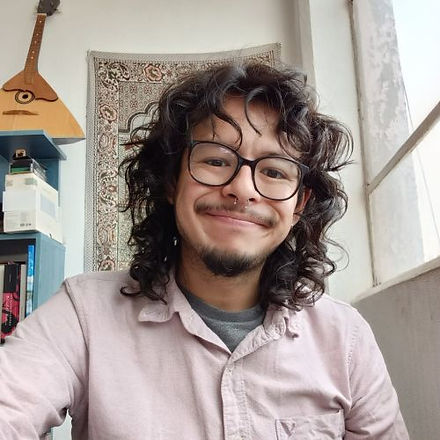
Interview with
Fernando Tovar Rubalcava
Name: Fernando Adrian Tovar Rubalcava
Nationality or Ethnicity: Mexican
Where do you live?: Mexico City, México
Languages: Spanish (mother language), English (C2), Italian (C1), German (C1), French (C1), Catalan (B1), Portuguese (B1), Arabic (B1), Japanese (N4), Dutch (A2), Nahuatl (A1/A2), Russian (A1), Mandarin Chinese (HSK1), Norwegian (A1), and some academic Latin and Ancient Greek.
Member since:
27 de mayo de 2026
1. What’s your story? How did you get into all these languages?
My journey into languages started when I was just five years old, driven by a lot of curiosity and three very specific childhood moments. The first one was watching the movie Spirited Away. My five-year-old brain couldn't understand how people in the film could read such complex characters like kanji and know exactly how to pronounce them without any trouble. In Spanish, my native language, a letter like 'A' is always just 'A', so seeing a highly visual script being decoded so naturally by native speakers completely blew my mind and made me realize that other writing systems existed. This was also the time when I grew up watching Studio Ghibli films with my grandmother, starting with Howl's Moving Castle and Spirited Away during the exact same afternoon. The second moment came from my favorite childhood treat, Kinder Surprise Eggs. I loved them, and I became fascinated by the safety warnings on the wrappers, which were printed in a huge variety of languages. It was the first time I saw so many languages grouped together. The third spark was a global label collection that Coca-Cola released. Seeing how a brand I drank every day looked completely different in other parts of the world was amazing to me, especially the Amharic script from Ethiopia, which became my absolute favorite.
I was always a big reader, learning to read at age three and writing by four. Since I had a rather quiet and solitary childhood, books and independent learning became my world. Around age eight or nine, even though internet access was limited and cost ten pesos an hour at the local cybercafe, I would use my allowance just to go print out Wikipedia pages about grammar, tenses, and linguistics so I could take them home and study them.
As I grew up, my path with languages combined self-directed learning with whatever school resources I could find. I started teaching myself Italian and German using old "without a master" textbooks. Then, against all odds for the Mexican public school system, I learned English in middle school. I’ve been speaking it since I was 11, and now at 26, I’ve actually been an English teacher for ten years. My German got much better in high school thanks to a supportive teacher. I told her I wanted to learn, so she gave me her schedule at the school’s media library, which was a self-access language center. I went to her study tables constantly, which really helped me solidifying my grammar. A few personal romances back then, including falling in love with a German teacher, also kept me very motivated. Today, I teach German too.
Catalan is a language I simply fell in love with the moment I heard it. I started studying it on my own at 17, and later, while doing four semesters of a Classical Humanities degree where I learned Latin and ancient Greek for translation, I took Catalan classes at the ENALT. I attended just as an auditor because I wasn’t officially enrolled, but the professor let me stay because my level was already pretty good. I made great friends there, eventually got a B1 certificate from the Institut Ramon Llull, and I'm planning to take the B2 soon.
When I turned 13, that early fascination with Japanese animation evolved, and I became a huge anime fan. That was the moment I began studying Japanese completely on my own just because I wanted to understand the language of my favorite shows. Today, I speak it at a level slightly above A2. My Japanese friends often joke that I communicate like a little kid when I speak it, and I know I still have a very long way to go with that language. Over my ten years as a teacher, I’ve taught English, German, Italian, Catalan, Spanish for foreigners, and even private Portuguese lessons.
French and Portuguese are unique to me because I’ve never taken a single formal class for either, yet I use them with high proficiency. I practiced Portuguese on my own for a long time since it’s close to Spanish, and during the pandemic, I joined language groups on Discord and made friends with people from São Paulo. Speaking with them every day really helped me fully adopt the language. My French is advanced enough that I currently teach French literature classes entirely in French.
Also during the pandemic, out of boredom and wanting a real challenge, I took an intensive Arabic course at the university level. Doing five semesters of Arabic at ten hours a week was intense, but it gave me a solid conversational B1 level, even if it’s a long road ahead. In 2022, I lived with a roommate from a town close to Amersfoort, Netherlands. I noticed Dutch sounded a bit like German and asked her to practice with me, but she told me not to bother because it was too hard and nobody spoke it. That comment just triggered my stubbornness, so I dove into Dutch and I'm now nearing a solid A2 level.
On top of all this, growing up in Milpa Alta means Nahuatl has always been around me, and I’ve picked up a basic foundation between A1 and A2. Right now, I also have basic "tourist" levels in Russian, Mandarin, and Norwegian. I’m not sure what language to focus on next, but I’ve been looking into Hungarian, Indonesian, and Nordic languages like Swedish, Danish, or Icelandic. Speaking Hungarian and Icelandic fluently are definitely my ultimate dream languages.
2. Which language(s) do you wish you could spend more time practising?
I would love to spend much more time practicing the languages where I struggle to find native speakers to share with on a regular basis. Specifically, I wish I could deeply practice my Japanese, Arabic, and Dutch. It is quite a paradox because even though Catalan has far fewer speakers globally than any of those three, I don't actually lack practice in it. I am currently taking a poetic creation course in Catalan and I use the language quite often because I am in close contact with many speakers. However, finding people to converse with in Arabic, Japanese, or Dutch is a completely different story, and those are the ones I feel need the most active maintenance right now. I would also include Italian on this list, though to a much lesser extent, just because I do not have many people around to speak it with anymore. Beyond maintenance, I really want to dedicate more focused study and regular practice to Nahuatl. For me, learning and speaking Nahuatl is a matter of personal ethics, deeply tied to the context of where I grew up in Milpa Alta and what this language represents for the Indigenous peoples of the Americas today.
3. What are some languages you’d like to learn in the future?
Answering this is actually quite complicated for me because, honestly, if I could, I would study every single language in existence. I don't really have a rigid checklist because I believe every language deserves to be learned and explored. If a personal situation required me to start learning Maltese tomorrow, even though it is only spoken in one tiny country, I would dive into it happily because I find it beautiful. My interests are vast and always expanding. I have always been fascinated by the complex structure of Albanian, the mysterious beauty of the Caucasus languages, and the gorgeous sound of Persian. I would also love to learn Modern Greek, explore the dialects of Arabic beyond the Modern Standard Arabic I already speak, and dive into languages from India or the absolute challenge of Tibetan.
I also have what I consider temporary linguistic failures from my past, though I don’t think they will stay failures forever. When I was younger, I tried studying Estonian, Korean, Ukrainian, Polish, Czech, Macedonian, and Turkish. They felt incredibly difficult and overwhelming at the time, but the door is definitely not closed on them. On top of that, I have a deep desire to explore more Indigenous languages of the Americas. The structural diversity of these languages causes a real longing in me to understand them. I am captivated by the languages of Oaxaca, and the first time I heard native Seri speakers, I was completely spellbound. These systems are light-years away from the linguistic structures currently in my head, but that is exactly what makes them so attractive. It is a bit sad that we don't have enough lifetimes to learn everything we want. If I could just download languages into my brain, it would be amazing, but at the same time, it would take away the magic, wouldn't it? The true beauty of a language is found in the struggle and the joy of actually studying it.
4. So let’s be honest, which language has the most charm for you?
This is a highly subjective question, and my answer is definitely open to changing in the future since I haven't heard every language in the world, but right now, Icelandic absolutely takes the crown. It is a language I don't speak yet, but I am completely obsessed with learning it one day. There is a certain je ne sais quoi about it; because of its voiceless consonants, it sounds as if people are constantly whispering. To me, it feels like they are using the wind itself to speak, and since the wind is one of my favorite concepts in life, I find that incredibly beautiful. Of course, other languages have stolen my heart in different ways. I actually love Dutch, which might be an unpopular opinion, but I am fascinated by its guttural sounds and the fact that you can find three different types of 'R' sounds depending on the dialect. The melody of Japanese and how its sentences are constructed is also gorgeous, and when I studied Arabic, the horizontal and vertical root system for deriving new words seemed like a brilliant, beautiful piece of engineering. Hungarian also stands up there as a major personal favorite, but if I have to pick the one that carries the most poetic charm for me right now, it is definitely Icelandic.
5. What’s the greatest pleasure you get from speaking so many languages?
There is a very specific feeling that I absolutely love, and it is the sensation that every single time I learn a new word or phrase in a different language, a whole new group of people somewhere in the world is unlocked for me. I instantly think about how I just opened up a path to communicate a specific concept with an entire community that isn't anywhere near my immediate surroundings. The ultimate joy for me is this ability to share with others and to connect with people through a language that isn't my own. I also have to admit that I really enjoy the look of pure surprise on people's faces—whether they are Dutch, German, Italian, or anyone else—when they realize that a Mexican guy from a semi-rural background who lives in Mexico City and has never actually left the country is speaking their language. I love that shock when they wonder why on earth I took the time to learn something like Dutch, and I just tell them it is because I think it sounds beautiful, and then I just keep chatting with them. But above all, the greatest pleasure is knowing that there are more people out there who can understand my thoughts, which feels priceless to me. That is the real reason we study languages, to truly connect. Using an intermediate language like English to talk to someone from Germany is fine, but speaking to them in German brings you so much closer to their home and directly to their heart.
6. Some people say the world is really just going to have a few languages left in a 100 years, do you think this is really true?
Sadly, language extinction is an ongoing reality that seems to move hand in hand with globalization. It feels intense to realize that every hundred or hundred and fifty years, humans feel the pressure to adopt whatever language belongs to the dominant empire of the era. We saw it with Latin centuries ago, with French during the Belle Époque, with English throughout the twentieth century, and we might see it next with Mandarin or other languages gaining global influence. Knowing that languages die every year genuinely breaks my heart because, to me, the death of a language is the death of an entire culture, thousands of years of people sharing ideas and passing their worldview down to their children. However, I don't believe we will be left with just a handful of languages in a century. While it is true that heavily endangered languages with little generational transmission will inevitably disappear, I also believe that technology is giving many communities the tools to standardize, protect, and secure the survival of their speech, even if this unfortunately won't save them all. If human language worked by simply collapsing into a few dominant ones, Europe would only speak Latin by now, but Latin changed and fractured. Even if one day the whole world used a single dominant language, languages are inherently alive and constantly changing. Because of that, I truly believe linguistic diversity will never really have an end.
7. What is your message to young (and not so young) people out there who are interested in studying multiple languages?
Do not let difficulty, or what people tell you, or how distant a language seems from your native tongue ever stop you. Never let anything hold you back, especially not the judgments of others about whether a language is useful or useless. Every single language deserves to be studied, and even if there were only one speaker left in the world, I would sit down with that last speaker to learn everything I possibly could. Don't listen to the opinions about practicality, or the typical comment that you should focus on English first because it is more important. If you love a language, go out and study it, because true acquisition is always born from genuine interest and love. As a language teacher, I am very particular about phonetics, and my best technical advice is to always start on the right foot by trying to mimic the phonetic system of the new language as closely as possible. This is the only way to break free from the sound system of your native tongue. Go and run after whatever language you find beautiful, because beauty inspires love, and when we love something, we stick with it. Let love be your engine rather than just thinking about what language will get you a job or a career opportunity. Of course, in the real world, knowing English or French makes a practical difference if you want to work in those environments, but if you happen to fall in love with how Polish sounds, don't waste time. When love calls, you have to answer. That is exactly what happened to me with Catalan; everyone told me it was useless, that very few people spoke it, and that those who did already spoke Spanish anyway, so why bother? My answer is that you must do it primarily for yourself. In Spanish, we have a saying that not even shoes fit if you try to force them, and it's the same with languages. If you do it out of obligation, it won't work. It will always be challenging because you never truly finish learning a language. There is no such thing as knowing one hundred percent of Spanish or one hundred percent of Chinese; there will always be a word you don't know, a concept you haven't seen, or a kitchen utensil you've never encountered. So let nothing stop you. Keep studying languages; even if today were the very last day of my life, I would still open a book to learn Modern Greek.