The International Association
of Hyperpolyglots
HYPIA
Est. 2016
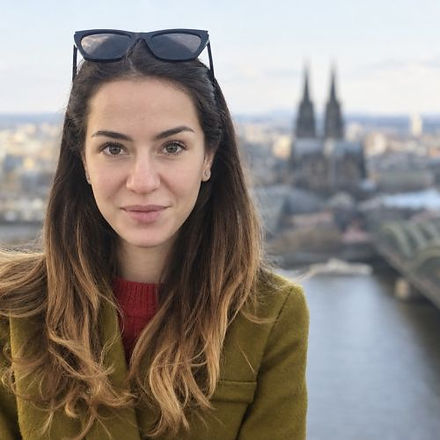
Interview with
Inna Volovyk
Name: Inna Volovyk
Nationality or Ethnicity: Ukrainian
Where do you live?: Vienna, Austria
Languages: Ukrainian, Russian, English, German, Polish, French, Dutch, Japanese, Hebrew
Member since:
25 de octubre de 2026
1. What’s your story? How did you get into all these languages?
I was born shortly after Ukraine gained independence from the USSR. My parents moved to Kyiv from the eastern part of the country, where Russian was more widely spoken. Growing up, I witnessed Ukrainian gradually become more than just a language: it increasingly came to symbolize national identity, strength, independence and resilience.
Proud to see Ukrainian become so widely spoken, especially because I didn’t really speak it myself as a child. My own interest in languages started at school, where I was studying English, German and French. Over time, it grew into a way to discover the cultures, social norms, humor and different ways of thinking behind each language. Today, I speak Ukrainian, Russian, English, German, Polish, French, Hebrew and Dutch, and I’m also learning Japanese.
Seems like I had a gift for languages from an early age, and my upbringing helped nurture it. My parents always encouraged me to learn languages and never treated them as something unnecessary or impractical. Looking back, I’m incredibly grateful for their support. It helped me shape a strong foundation and develop a skill set that later contributed to some of my greatest achievements. As I grew older, languages became my source of inspiration and a way to understand the world, and perhaps even discover new sides of myself.
2. Which language(s) do you wish you could spend more time practicing?
Japanese is the one I don’t use much in daily life. There is still so much I cannot express, so much vocabulary to learn and so much cultural context I am only beginning to understand. I’d love to reach the point where I can have spontaneous conversations and enjoy Japanese books, films and everyday interactions without constantly stopping to decode what is happening.
I would also like to keep my other languages active. Knowing a language and being able to use it comfortably are not quite the same thing. Ideally, I would have enough time to practice all of them without turning something I love into a second full-time job.
3. What are some languages you’d like to learn in the future?
There are so many! The first ones on my list are Spanish and Italian. They share many similarities, and I hope knowing French will help me learn them relatively quickly.
Beyond those two, I’d love to learn Arabic and Chinese. Both could open up new professional opportunities across the Middle East, North Africa and East Asia. Knowing Hebrew might make Arabic a little easier for me, while many Japanese kanji are borrowed from Chinese characters (even though their meanings and pronunciations can differ).
I know all four will take years to learn, but that’s the part of what makes the idea exciting.
4. So let’s be honest, which language has the most charm for you?
French has a special kind of charm for me. During the COVID pandemic, I returned to studying it almost daily and joined Toastmasters, where I had the chance to give speeches in French. Those weekly online meetings helped me through a difficult period, and French somehow became associated with gradually regaining my confidence.
There’s something about its sound that makes me feel a little more elegant and self-assured – as if the language itself gives me permission to take up a bit more space. Or perhaps the stereotype of French arrogance has a practical explanation: learn French, and eventually you start acting as though you have an opinion on everything and excellent reasons for having it.
Japanese has a different kind of charm. Not only do I love how it sounds, but also how much there is to discover through it: social conventions, symbolism and cultural ideas that keep giving me new questions to explore.
5. What’s the greatest pleasure you get from speaking so many languages?
My brain builds connections I don’t always notice consciously, and the results often surprise me. It’s never about fluency, grammar or vocabulary.
Sometimes I picture people’s minds as galaxies: every new idea adds a star, but it can also create new connections between the ones already there. Learning a language may change more than our vocabulary; it can gradually change how we interpret the world. You may never use that language professionally, but it connects you to people who can influence your life more than money.
A study in the Journal of Research in Personality by Nairán Ramírez-Esparza and her colleagues explored how Spanish–English bilinguals answered personality questions in each language. The results suggested that language and cultural context influence how people express certain traits. This doesn’t mean we become different people when we switch languages, but it makes me think about cultural frame switching. Our self-expression is more flexible than it seems, and language quietly shapes it.
6. Some people say the world is really just going to have a few languages left in 100 years, do you think this is really true?
I think the risk is real, although predicting exactly what the world will look like in a hundred years is difficult. Linguists estimate that around 40% of the world's languages are endangered, and most of them don't disappear through one dramatic event. They fade through quiet, rational choices: parents pick the language that will give their children better opportunities, and I wouldn't blame anyone for that.
My own country shows that such choices are not always entirely free. Ukrainian was restricted in print under the Russian Empire and marginalized for decades under the USSR, and I think that legacy is part of why I didn't really speak it myself as a child. Yet the language survived, and in recent years I've watched many Ukrainians, including native Russian speakers, consciously switch to it. To me, this shows that a language can be pushed out by pressure, and that it can come back when people decide it matters.
A language carries more than information: it preserves stories, humor, collective memory and ways of interpreting experience. When it disappears, we lose access to a distinctive cultural perspective that cannot always be fully translated into another language. Ideally, we should be able to learn languages that connect us globally while also protecting the conditions that allow smaller ones to survive.
7. What is your message to young (and not so young) people out there who are interested in studying multiple languages?
Do not underestimate what a particular language can give you simply because you cannot immediately monetize it. We often feel that everything we do should improve our career or income, but the value of learning languages goes far beyond practical benefits. I am convinced that every language makes us, in a sense, another version of ourselves. It may be difficult to measure scientifically, but it captures something meaningful about the experience.
I started learning Japanese on 1 June 2025, following a routine of 30–60 minutes a day and one day off each week. I’ve managed to keep it for many months, which made me proud, especially because I had never thought of myself as naturally disciplined. I have always been stubborn, but learning Japanese taught me that consistency is a skill you can develop. And along the way, I discovered cultural patterns and perspectives that I might never otherwise have explored.
After I applied to HYPIA, someone reached out to me on LinkedIn to say that my story had encouraged them to finish their own application. Moments like that are a good reminder of how our passion can influence people in ways we don’t expect.